Top 5 Challenges in Maritime Crew Planning
Crew planning is tougher than ever: limited supply of qualified officers, evolving regulations, and pressure to run on-time voyages with lean teams. Many operators still rely on manual tools and email threads, which hide costs and create avoidable risks. Let’s look at the top five crew planning challenges shaping today’s maritime operations — and how a modern crew planner and connected crew planning software reduce friction, errors, and spend.
The Hidden Costs of Manual Crew Scheduling
What used to be a straightforward rotation is now a complex puzzle of endorsements, visas, medicals, port restrictions, relief windows, and budget controls. In many companies, scheduling still happens in shared spreadsheets and email chains. The result: version drift, duplicated entries, and late-breaking surprises that translate into real money — delays, rebooking fees, agency overtime, and idle time.
A connected crew planning platform makes schedule logic explicit, validates compliance before confirmation, and keeps your shore and ship teams aligned in real time.
Challenge 1 – Crew shortages & retention problems
Global demand for qualified officers outpaces supply. As highlighted by industry reports (BIMCO/ICS, Seafarer Workforce Report 2021), the market faces a material shortfall — historically cited as a projected officer gap of +89,510 by 2026. Shortages cascade into overtime, unstable rosters, and higher replacement and training costs.
- HR Directors: Unplanned churn inflates hiring and training budgets.
- Crew Managers: Line-ups slip as candidates fall through manual cracks.
- Managing Directors: Strategic risk to service quality and charterer obligations.
Seafarer Workforce Dynamics (BIMCO/ICS 2015–2026)
| Year | Estimated Demand for Officers | Estimated Supply | Shortfall (Demand – Supply) |
|---|---|---|---|
| 2015 | ~790,500 | ~774,000 | ~16,500 |
| 2021 | ~889,540 | ~863,300 | ~26,240 |
| 2026(forecast) | ~950,000 (est.) | ~860,500 (est.) | ~89,510 (projected) |
Officer Demand vs Supply Trend (2015–2026)
- Demand
- Demand
- Supply
Source: BIMCO / ICS Seafarer Workforce Report 2015 & 2021 Editions. Used under fair reporting for informational purposes. © BIMCO and International Chamber of Shipping.
Source: BIMCO / ICS Seafarer Workforce Report 2015 & 2021 Editions.
With crew planning software, you predict rotations and build a live pipeline: ranked shortlists by vessel type, endorsements, and availability; alerts for expiring documents; and proactive outreach to reduce last-minute scrambles.
Challenge 2 – Certification & regulatory complexity
Crewing sits at the crossroads of STCW, MLC 2006, flag-state rules, client matrices, visas, and medicals. One expired certificate or mismatched endorsement can trigger a port delay, a fine, or a lost charter. For managers, manual expiry tracking across spreadsheets becomes unmanageable at fleet scale.
A digital crew planner validates each assignment against rank rules and matrix requirements, surfaces gaps in advance, and generates audit-ready evidence for PSC and vetting. That means fewer last- second changes and fewer calls to agents at midnight.
Challenge 3 – Fatigue & watchkeeping risks
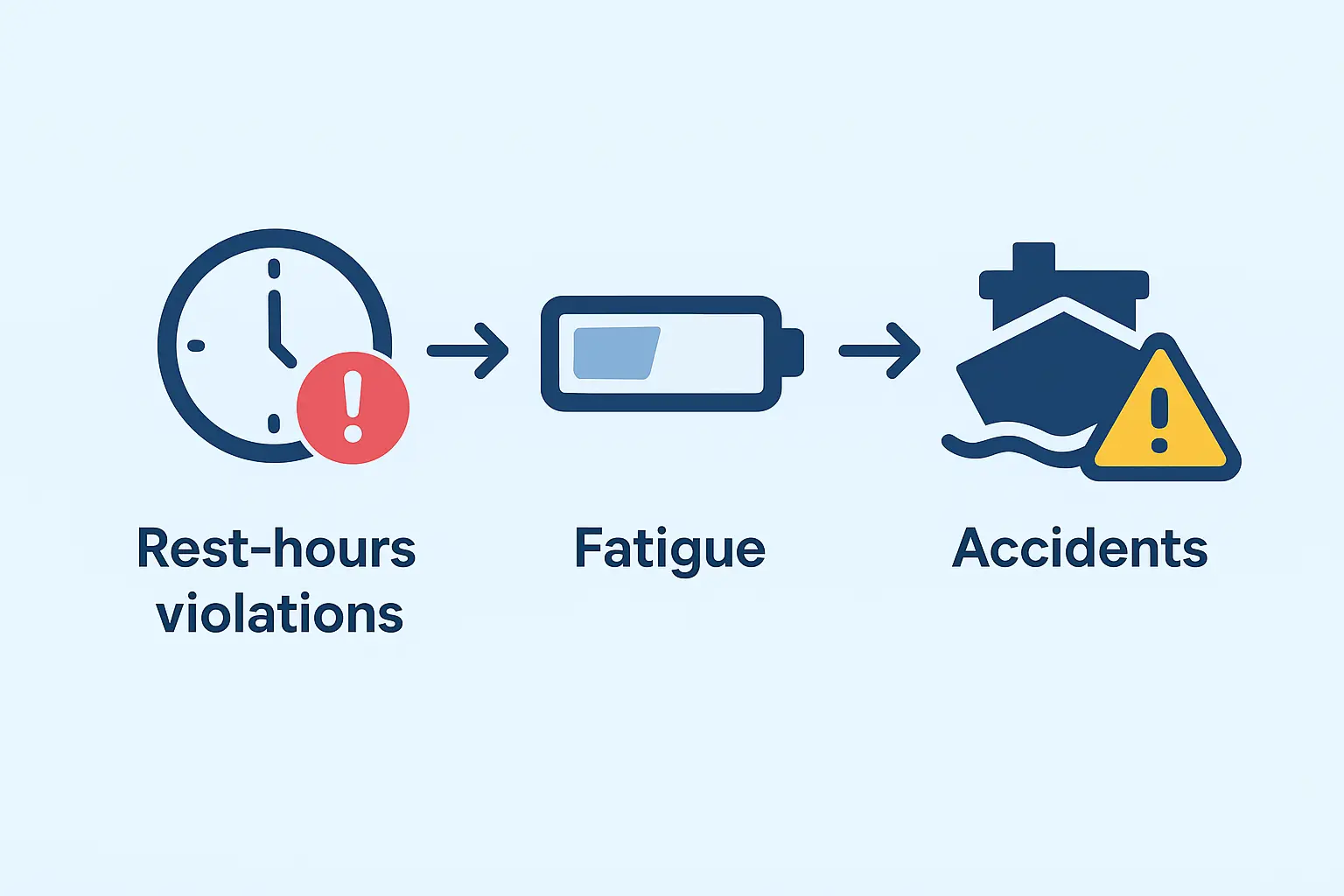
Human factors remain a leading cause of incidents. When rosters are stretched by shortages and manual overrides, breaches of hours-of-rest creep in — and fatigue follows. Fatigue is invisible until it isn’t: it shows up as poor decisions, slow reactions, and near-misses that become real incidents.
Automated planning blocks non-compliant schedules before publication, enforces MLC rest limits, and gives DPA/HSEQ teams a consolidated view of risk. The payoff is fewer breaches, fewer findings, and safer, steadier operations.
Challenge 4 – Manual scheduling and data duplication
Spreadsheets invite chaos: conflicting versions, free-text edits, and copy-paste errors. A duplicated crew profile or stale date can put the right person in the wrong port — with rebooking fees, agent overtime, and lost time. For HR, hours disappear into reconciliation; for managers, transparency vanishes.
A unified crew planning workspace becomes the single source of truth: live data shared across planning, travel, payroll, and compliance. Edits propagate instantly; approvals leave audit trails; notifications keep stakeholders aligned.
Challenge 5 – Cultural and training gaps in crewing
Mixed-nationality crews bring strengths — and challenges. Different languages, training backgrounds, and safety habits can cause misunderstandings on the bridge and in the engine room. Without shared standards, even routine procedures can drift, affecting HSEQ and morale.
Modern platforms track competencies, languages, and training history by rank and vessel, helping planners assemble balanced teams and schedule targeted refreshers. Clear, consistent expectations reduce friction and improve retention.
Short-term fixes vs strategic solutions
Overtime and manual cross-checks are firefighting — they don’t eliminate the root cause. The evolution is clear: Reactive (patching last-minute gaps) → Proactive (standardized workflows and live validation) → Predictive (what-if scenarios and demand forecasting).
- HR Directors: Predictable budgets and measurable ROI.
- Crew Managers: Stable rosters and fewer last-minute scrambles.
- Managing Directors: Control, scalability, and audit-ready operations.
Digital transformation isn’t about replacing people — it’s about giving them real-time insight. A connected crew planner and integrated crew planning software turn hidden costs into controlled processes.
Conclusion
The five challenges — staff shortages, certification complexity, fatigue risk, manual inefficiency, and cultural gaps — all point to the same outcome when handled by spreadsheets: lost control, higher costs, and increased safety exposure. Moving to digital crew planning brings predictability, transparency, and audit readiness across the fleet.
Discover how modern tools help maritime leaders transform their crew planning from reactive to reliable. Explore planning dashboards, matrix validation, rest-hours control, and integrated travel workflows — all aligned around a single source of truth.
Discover how Sealogic E-CMS helps maritime leaders transform their crew planning from reactive to reliable.
We maintain a live demo environment at demo.sealogic.eu so you can explore the system. For security reasons, demo login credentials are provided on request.